
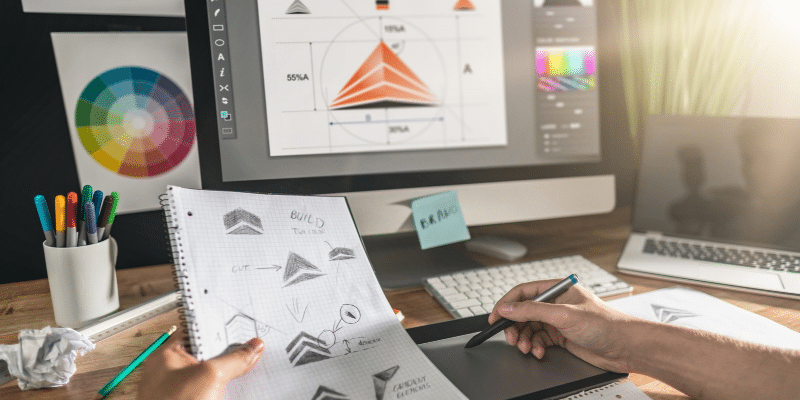
Graphic design for business is the visual side of how a company communicates: the logo on your truck, the layout of your website, the brochure you leave behind after a sales meeting. Every one of those pieces tells customers something about you before anyone reads a word.
Most companies need more types of design than they realize, but not all at once. Below, we break down the 10 types that matter most, where each one shows up in your business, and how to decide what to tackle first.
Key Takeaways
- Your logo and brand identity come first. Every other type of design builds on them.
- Website, marketing and print design do the day-to-day selling, so they need to look like they came from the same company.
- Packaging, motion graphics and infographics matter more for some businesses than others. Prioritize based on how your customers buy.
- Hiring a freelancer, an in-house designer or an agency each makes sense at different stages of growth.
Why Graphic Design Matters for Your Business
People judge what they see fast. A study published in Behaviour & Information Technology found that visitors form an opinion of a web page’s visual appeal in about 50 milliseconds. That’s before they’ve read your headline, seen your prices or found your phone number.
Good design earns you a few things that are hard to get any other way:
- Credibility. A polished, consistent look signals that you take your business seriously, which makes it easier for customers to trust you with theirs.
- Recognition. When your colours, fonts and logo show up the same way everywhere, customers start to remember you without trying.
- Clarity. Strong layouts guide people to what matters, whether that’s a service, a price or a “Book Now” button. Our breakdown of eye-tracking research shows how much placement affects what visitors actually notice.
- Conversions. Ads, landing pages and sales sheets that are easy to scan get more people to act.
Ready to Grow Your Business Online?
From websites and SEO to digital advertising, we create marketing strategies that help your business attract more customers and grow.
10 Types of Graphic Design Every Company Needs
1. Logo Design
A logo is the graphic design used to represent a company. It’s the mark people see on your signage, invoices, uniforms and social profiles, and it’s usually the first piece of design a business pays for.
A good logo is simple enough to read at the size of a browser tab and distinct enough to stand apart from competitors. That’s a big reason so many large companies have simplified their logos in recent years. Most businesses also need a few variations, like a stacked version or a standalone icon, and alternate logos keep things legible wherever your brand appears.
2. Brand Identity Design
Your logo is one piece of a bigger system. Brand identity design covers your colour palette, typography, imagery style, icons and the rules for using them, usually documented in a brand guide.
That guide is what keeps a flyer designed in March looking like it belongs with a website built in October. It also makes life easier for anyone creating content for you, from a new hire to an outside printer. Visuals are only half the picture, though. Your brand’s voice, values and customer experience shape how people feel about you just as much.
3. Website Graphic Design
For most companies, the website is the hardest-working piece of design they own. It’s where people go to check you out after seeing an ad, getting a referral or driving past your shop.
Website graphic design covers the visual layer with the page layouts, hero images, colour use, icons, buttons and the overall look of each page. The goal is a site that looks like your brand and makes it easy to find information and get in touch. Well-executed web design pairs these visuals with clear structure and strong calls to action.
4. User Interface (UI) Design
UI design focuses on the parts of a screen people interact with, such as menus, forms, buttons, filters and checkout flows. If your business has an online store, a booking system, a customer portal or an app, UI design decides how easy those tools are to use.
It overlaps with website design, but the priority is different. Website design shapes how your brand looks online, while UI design shapes how smoothly people get things done. A confusing form or a hard-to-find “Add to Cart” button costs sales, no matter how good the rest of the page looks.
5. Marketing and Advertising Design
This is the design behind your campaigns, including social media posts, display ads, email headers, landing pages and promotional graphics. It needs to grab attention quickly and push people toward a single action.
Marketing design also has the shortest shelf life. You’ll likely need fresh creative every season, for every promotion, in several sizes for different platforms. Businesses running paid ads or posting regularly on social media go through a lot of it, so consistency with your brand guide matters even more here.
6. Print Design
Digital gets most of the attention, but print is still how many businesses make an impression in person. Business cards, brochures, rack cards, signage, banners, vehicle wraps, letterhead and trade show displays all fall under print design.
Print comes with its own technical requirements, like bleed, resolution and colour modes, that don’t apply on screen. A design that looks sharp on a monitor can print muddy or get cropped badly if those details are missed. Working with designers who handle graphic design and print together avoids expensive reprints.
7. Packaging Design
If you sell physical products, your packaging is part salesperson, part shelf sign. It has to stand out next to competitors, communicate what’s inside and meet labelling requirements, all within a few square inches.
Packaging design also extends to labels, hang tags, shipping boxes and inserts. For e-commerce brands, the unboxing experience is often the first time a customer physically interacts with your business, so it’s worth getting right.
8. Motion Graphics
Motion graphics bring design to life through animated logos, explainer videos, animated social posts and video ads. They’re especially useful for explaining a complex service or product in a few seconds.
Video has become a standard part of the marketing mix. In Wyzowl’s 2026 State of Video Marketing survey, 91% of businesses said they use video as a marketing tool, and 93% of video marketers said it increased people’s understanding of their product or service. Simple animations built from your existing brand assets are often a cost-effective place to start.
9. Corporate and Internal Design
Not every piece of design is customer-facing. Pitch decks, proposals, annual reports, employee handbooks, presentation templates and internal signage all reflect your brand too.
This type of design often gets left until last, which is how companies end up with ten different PowerPoint styles floating around. A few well-built templates save your team time and keep proposals looking professional when they land in front of a potential client. Consistent internal materials also support employer branding when you’re hiring.
10. Infographics and Data Visualization
Infographics turn numbers, processes and comparisons into visuals people can take in at a glance. Think project timelines, service comparisons, annual results or a step-by-step look at how you work.
They’re useful in blog posts, sales materials, reports and social media, and they’re far easier to share than a wall of text. Simple charts and diagrams can be made in-house with the right design tools, but anything going into a pitch or a public report is worth having designed properly.
Ready to Grow Your Business Online?
From websites and SEO to digital advertising, we create marketing strategies that help your business attract more customers and grow.
Which Types of Graphic Design Should Your Business Prioritize?
Few companies need all 10 types at once. What you invest in first depends on where your business is and how customers find you.
| Business stage | Start with | Add next | Can wait |
| New business or rebrand | Logo, brand identity, website | Business cards and core print pieces, social media templates | Motion graphics, internal templates |
| Growing business | Marketing and ad design, website updates | Print collateral, infographics for sales materials | Large-scale packaging redesign |
| Established company | Refreshed brand guide, consistent templates across teams | Motion graphics, corporate reports and pitch decks | Little should wait; focus on keeping everything consistent |
| Product-based business (any stage) | Logo, brand identity, packaging | Website and e-commerce UI | Corporate materials |
If you’re not sure where your gaps are, line up everything customers currently see from you, such as your website, social posts, business cards, signage and proposals. Anything that doesn’t look like it came from the same company is a good place to start.
Freelancer, In-House Designer or Agency?
There’s no single right way to get graphic design done. Each option has trade-offs, and many companies end up using a mix.
| Freelancer | In-house designer | Agency | |
| Best for | One-off projects, small budgets | Steady, high-volume design needs | Brand launches, rebrands, multi-channel campaigns |
| Cost structure | Hourly or per project | Salary, benefits, software and equipment | Per project or monthly retainer |
| Range of skills | Usually specializes in one or two areas | One person’s skill set | A team covering branding, web, print and marketing |
| Strategy and brand oversight | Varies by person | Builds deep knowledge of your business over time | Brings outside perspective and process |
| Watch out for | Availability and consistency across projects | Bottlenecks when one person handles everything | Choosing a team that understands your industry |
A common pattern is to have an agency build the brand identity, website and core templates, then use an in-house team or freelancer to produce day-to-day content from those assets.
How Much Does Graphic Design Cost?
Prices vary widely based on the type of project, the experience of the designer and how much strategy is involved. A few benchmarks help set expectations:
- Freelancers: Upwork puts typical rates for freelance graphic designers on its platform at US$15 to $35 per hour, with experienced specialists charging well above that. The same guide estimates a logo at 5 to 20+ hours of work and a flyer at 1 to 10+ hours.
- In-house designers: In Canada, the median wage for a graphic designer is $31.25 per hour, according to Job Bank (2023–2024 data). Add benefits, software licences and equipment to get the true cost of a hire.
- Agencies: Most quote per project or on a retainer. Pricing reflects the strategy, revisions, production management and range of specialists involved, rather than design hours alone.
Whatever route you choose, the biggest cost drivers are usually the number of deliverables, how many rounds of revisions are included, whether strategy and research are part of the work, and how quickly you need it done.
Frequently Asked Questions
What graphic design is used to represent a company?
A logo. It’s the core visual mark of a business and appears on everything from signage to social media profiles. It’s usually supported by a wider brand identity that includes colours, fonts and imagery guidelines.
What’s the difference between graphic design and branding?
Branding is the overall perception of your business, including your values, voice, reputation and customer experience. Graphic design is how much of that brand gets expressed visually, alongside the other key elements of a brand identity.
Does a small business really need professional graphic design?
Yes, at least for the foundations. A professionally designed logo, brand guide and website give you assets you’ll use for years. Smaller, everyday pieces like social posts can often be created in-house from templates once those foundations are in place.
How often should a business update its graphic design?
Marketing graphics change constantly, often with every campaign or season. Websites typically need a visual refresh every few years. Logos and brand identities last longer, but are worth reviewing when your business changes direction, expands its services or starts to look dated next to competitors.
Can I use templates or DIY design tools instead?
For simple, short-lived content, absolutely. Templates become a problem when they replace your core brand assets, because anyone can use the same template, and your business ends up looking like everyone else’s.
Build a Brand People Recognize
The best graphic design for business shows up the same way everywhere your customers look, so they remember you and trust you when they’re ready to buy.
Our in-house designers handle everything from logo design and branding to websites, print and campaign creative, so every piece fits together. Ready to get started? Contact our team to talk about what your business needs.
